Robinhood Chain Is Mixing Stocks, Memecoins and DeFi. Welcome to Programmable Everything
Robinhood built a blockchain to bring traditional assets onchain.
The internet brought the memecoins.
That may sound like a detour, but it could be a preview of something much bigger.
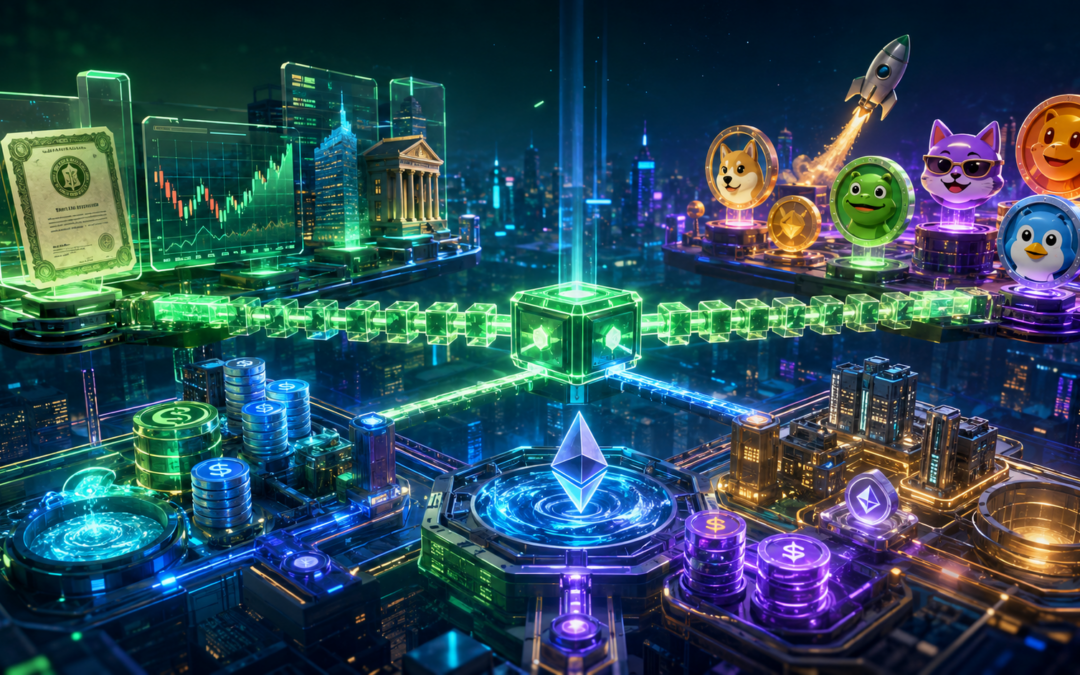
Robinhood Chain launched as an Ethereum Layer 2 built with Arbitrum technology. Its central proposition is to combine tokenized stocks and other real-world assets with the always-open markets and programmable applications of decentralized finance. The network supports stock tokens, decentralized exchanges, lending, borrowing and perpetual futures.
Then speculation arrived.
Memecoins quickly became one of the chain’s largest sources of trading activity. By late July, they represented about 79% of decentralized-exchange volume, while trading in real-world assets was growing but remained far smaller.
By the end of August, memecoin applications were generating much of the network’s app revenue, with roughly 22,600 new tokens being created in a single day.
It is tempting to call this a failure of the original vision.
It may actually be the messy beginning of it.
Stocks Are Becoming Building Blocks
A conventional brokerage account allows investors to buy, hold and sell stocks.
A tokenized stock can potentially do much more.
It can trade around the clock. It can move between compatible applications. It can enter a lending pool, serve as collateral, be deposited into an automated portfolio or settle directly against another tokenized asset.
Robinhood says eligible users in more than 120 countries can access its new Stock Tokens, although availability varies by jurisdiction. Those tokens can be traded through decentralized exchanges and potentially deployed into lending and collateral applications.
There is an important legal distinction: Robinhood’s Stock Tokens are structured as tokenized debt securities providing economic exposure to underlying securities. They do not necessarily grant the holder direct legal or beneficial ownership of the underlying shares, and they are not available to U.S. persons.
That detail matters.
Tokenization can make an asset programmable without making it identical to the original asset.
Why Memecoins May Help the Serious Products
New financial infrastructure rarely begins with its most respectable use case.
The early internet grew through chat rooms, games and entertainment before transforming business. Smartphones were popularized by consumer applications before becoming essential enterprise infrastructure. Crypto networks have repeatedly used speculation to attract the users, liquidity and developers needed to support more durable markets later.
Memecoins bring:
- Attention
- Trading volume
- Liquidity
- New wallets
- Application development
- Fee revenue
- Stress testing under real demand
Those ingredients can benefit tokenized stocks and real-world assets, even if the initial activity looks frivolous.
The danger is that speculation overwhelms everything else. Thin liquidity, manipulation, scams and extreme volatility can damage the credibility of a network trying to attract regulated assets.
Robinhood therefore faces an unusual balancing act: allow permissionless experimentation while creating enough trust for stocks, funds and institutional capital.
From Asset Classes to Asset Legos
The most important innovation is not that stocks can trade beside memecoins.
It is that they may eventually interact.
Imagine using a tokenized portfolio as collateral for a dollar loan. An automated agent could monitor the collateral, rebalance the portfolio, hedge exposure with perpetual futures and move idle cash into an onchain lending market.
A creator could issue a community token whose treasury holds tokenized index funds.
A decentralized exchange could support a market between a memecoin and a tokenized share of Nvidia rather than quoting everything in dollars. That is already beginning to emerge on Robinhood Chain, where stock-paired memecoin markets have appeared.
Once assets share programmable infrastructure, the distinctions between brokerage, banking, payments and decentralized finance begin to blur.
The Agentic Layer Comes Next
Robinhood is also preparing agent-connected crypto trading accounts that can scan data and execute strategies within capital limits and safety controls established by the user.
That points toward a financial system in which assets are not only programmable—financial decisions are programmable too.
Your stock tokens could become collateral. Your stablecoins could generate yield. Your AI agent could manage risk. Your wallet could become a brokerage account, bank account and automated treasury simultaneously.
This creates extraordinary potential, along with new forms of smart-contract, oracle, liquidity, counterparty and automation risk.
Tokenization does not merely put old assets on new rails. It allows assets, markets and software to interact as one system.
Robinhood Chain’s strange combination of stocks, stablecoins, memecoins, lending and automated trading may look chaotic today.
But financial convergence often looks chaotic before it looks inevitable.
Welcome to programmable everything.