When AI Takes Over Trading, Will Crypto’s Biggest Asset Be Belief?
The next memecoin cycle could test whether online communities can turn shared identity into lasting economic value.
Imagine opening your trading app and realizing that nearly every advantage you thought you had has disappeared.
The bots spot a new token before you do. They analyze wallets faster, process social signals around the clock, and execute trades while you are still deciding whether the chart looks promising.
You can access an AI assistant, too. But so can everyone else—including firms with better data, more computing power, and deeper pockets.
What happens to human traders in that market?
One provocative answer runs through this transcript’s vision of crypto’s future: people may increasingly move toward assets they hold because of what they believe, who they belong with, and what they want to build.
That is the foundation of what the speaker calls the “fat movement thesis.” Its central prediction is that communities with strong identities could capture a larger share of crypto’s value as technology becomes easier to reproduce and trading becomes harder to win.
It is an ambitious argument. It also raises a difficult question: when does collective belief create something durable, and when does it simply keep people invested in a story?
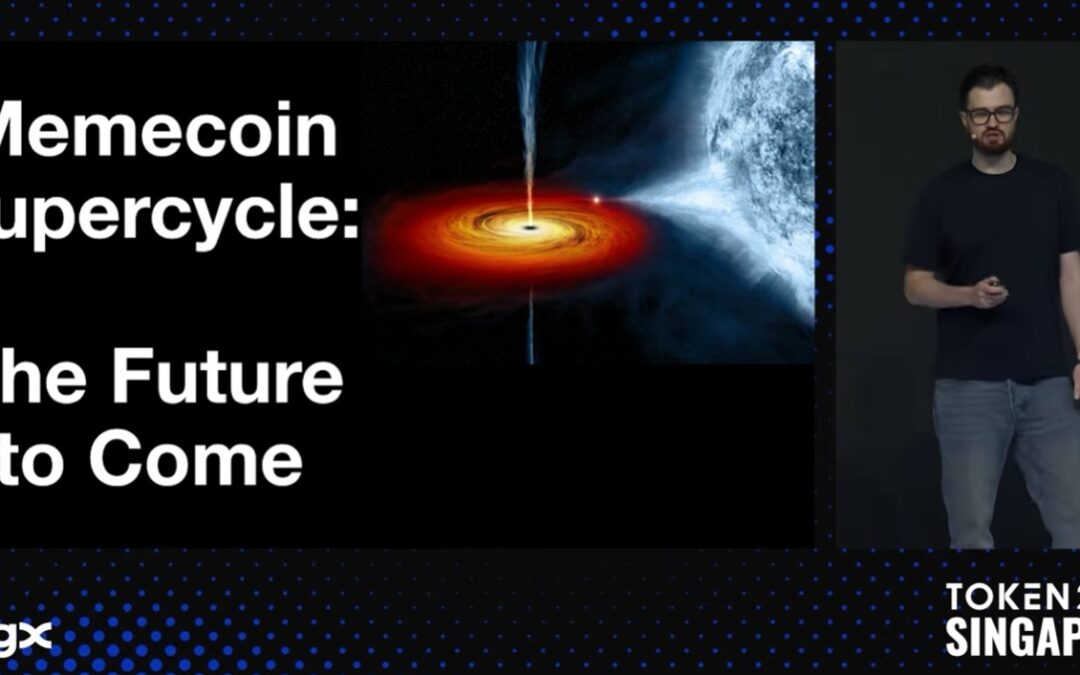
Murad Mahmudov – The Memecoin Supercycle: Two Years Later – TOKEN2049 Singapore 2026
The Search for an Economic Way In
The argument begins with financial frustration.
For people struggling to afford housing, build savings, or establish financial security, the distance between working for money and owning appreciating assets can feel enormous. A rising market offers little comfort to someone who has little invested in it.
The speaker sees that divide as a driving force behind speculative behavior. When conventional progress feels too slow, a token that might multiply overnight can look like a shortcut.
Crypto sits alongside sports betting, short-dated options, and other markets competing for that desire to get ahead quickly.
But a market’s most visible success stories reveal little about the typical participant. The spectacular winner becomes a screenshot. The losses are scattered across thousands of accounts.
The transcript argues that this imbalance has helped turn parts of crypto into an extraction system: traders compete for sudden gains while platforms and intermediaries collect fees from repeated activity.
Its proposed escape is collective commitment—people pooling their attention, labor, and capital around a community rather than continually chasing the next launch.
Whether that produces better outcomes depends on how the community works.
AI Could Make the Trading Race More Unequal
The speaker predicts that AI will intensify competition in speculative markets.
That is plausible as a direction, though the transcript’s claim that AI will effectively displace entire categories of human trading remains a forecast.
The mechanism is straightforward. Automated systems can monitor more information, react more consistently, and operate across more markets than a person working alone. As those capabilities spread, strategies based on spotting an obvious signal a little faster may become less useful.
Giving everyone a bot does not necessarily give everyone an equal chance. Access to data, execution quality, capital, and system design still matters.
The resulting pressure could change human behavior. Some participants may stop trading. Others may move toward longer time horizons, where their decisions depend less on immediate execution.
The speaker expects that shift to benefit communities organized around enduring conviction.
There is a crucial qualification: holding longer does not make a weak asset stronger. A token can lose relevance, liquidity, or value over years just as it can over minutes.
A longer horizon changes the competition. It does not remove the need for judgment.
Crypto’s Three Sources of Value
One of the transcript’s most useful ideas is its division of crypto valuation into three broad components.
The technical premium reflects what a network or product can do: security, privacy, speed, cost, programmability, and credible scarcity.
The financial premium reflects economic activity: fees, revenue, profits, and whatever mechanisms connect that activity to a token.
The social premium reflects the people around it: their trust, shared identity, narrative, commitment, and willingness to bring others in.
These categories overlap. Technical credibility can strengthen a community. A community can attract developers and customers. Financial success can reinforce belief.
The speaker’s larger claim is that AI could make some technical capabilities easier to copy, increasing the relative importance of the social premium.
A functioning product can be reproduced. A community with years of shared history is harder to recreate on demand.
Still, this framework is a way to ask better questions, rather than a formula that calculates fair value. Enthusiasm can support demand, but it cannot establish what a token ought to be worth.
From Memes to Movements
Memecoins are often treated as disposable jokes. The transcript proposes a broader interpretation: some are symbols around which people organize.
The speaker describes a “donation box–megaphone” model. Participants contribute money, time, creativity, and attention to amplify an idea they want the world to hear.
In that model, a token helps coordinate people who share a sense of humor, frustration, ambition, or belonging. Their contribution may include artwork, events, education, software, introductions, or distribution.
The distinction between a passing meme and a durable movement lies in what happens after the initial attention fades.
Does the community continue creating? Does it welcome useful disagreement? Are there reasons to participate during a quiet market? Can it accomplish something beyond persuading the next person to buy?
Those questions matter because intense commitment can take different forms. It can support collaboration and patient building. It can also reward conformity, discourage scrutiny, and make leaving feel like betrayal.
A strong identity is valuable to a community only if members retain the freedom to think independently.
Participation Needs an Economic Foundation
The transcript makes another striking prediction: tokenized communities could eventually become a major source of work.
That possibility deserves attention. Online communities already depend on people who organize, moderate, teach, design, publish, and build. Tokens could offer additional ways to coordinate or compensate those contributions.
But compensation requires resources.
A rising token price is not a dependable operating budget. If a community pays contributors entirely through its own token, those contributors still need buyers when they want to cover real expenses.
A sustainable model needs a clear answer to where funding comes from. That might include customers, memberships, sponsorships, services, products, grants, or a carefully managed treasury.
The important connection is between useful work and a credible means of supporting it.
Without that connection, a proposed participation economy can become a cycle in which members promote the token to finance continued participation.
A Token Can Coordinate Belief—and Distort It
The speaker predicts that movements with tokens will outperform movements without them.
Tokens can give participants a shared economic stake. They can make ownership transferable and provide mechanisms for rewards, access, or governance.
They also introduce competing incentives.
A member may want the community to pursue its mission. A large holder may want an exit. A contributor may need reliable pay. A speculator may care mainly about the next burst of attention.
Those interests sometimes align, but alignment takes design and accountability.
Buying a token also does not automatically redistribute wealth toward ordinary participants. Outcomes depend on who received the supply, who controls it, when people enter, and whether they can exit.
Shared ownership is a design choice. Fair outcomes require evidence.
The Real Test of the Movement Thesis
The transcript ends with extraordinary predictions, including the possibility that a memecoin could surpass Bitcoin and eventually the entire stock market in value.
Those claims are speculative. The transcript does not establish a basis for treating them as likely outcomes.
The more useful idea is that human connection may become increasingly important as automated systems produce more content, software, and market activity.
People will still seek trusted groups, meaningful work, recognition, and a sense of agency. Crypto communities could help meet some of those needs. Their success will depend on whether they create value that survives beyond speculative excitement.
For builders, that suggests a practical test: give people a reason to join, a worthwhile way to contribute, and a reason to stay when prices stop rising.
Belief can bring a community together. What its members build together determines whether that belief lasts.
From PvP to Participation: Where Normie Fits in Crypto’s Community Movement
If crypto’s next chapter revolves around belonging, shared identity, and collective action, Normie has a natural starting point: giving ordinary people a reason to participate.
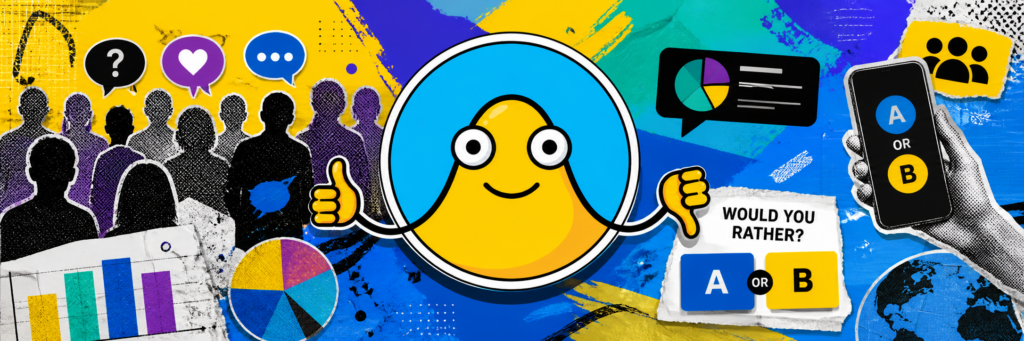
Would you rather compete against trading bots—or help build a community around something you enjoy?
That question captures an opportunity for Normie.
In his TOKEN2049 presentation, Murad Mahmudov argues that increasingly sophisticated AI could push human participants away from rapid speculation and toward tokenized movements. Shared identity, conviction, and community could become more important sources of value.
Normie fits part of that narrative already. Its personality polls invite people to explore their preferences, compare perspectives, and share questions with others. Its website combines that experience with a recognizable character, social channels, a player portal, and links to its crypto token.
The opportunity is to turn those ingredients into a community whose value grows through participation.
Normie’s strongest potential position is a place where ordinary people have a voice—and something worthwhile to do together.
Understanding the Shift From PvP to PvE
In gaming, PvP means player versus player. Crypto uses the term to describe environments where participants compete to capture gains from one another: getting in earlier, reacting faster, or selling before demand disappears.
That can produce an exhausting community dynamic. Everyone appears united while the price rises, but participants may have very different exit plans.
PvE means player versus environment. Applied to a community, it describes people working together on shared challenges.
For Normie, those challenges could include making online conversation more interesting, helping people understand different perspectives, and creating entertaining content that brings newcomers into the experience.
The distinction concerns behavior. A tradable token remains exposed to speculation even when its community pursues a shared mission.
Normie would move toward a PvE culture by making collaboration more rewarding and visible than price obsession.
Normie Starts With an Accessible Activity
Many crypto projects require newcomers to understand wallets, exchanges, tokenomics, and technical language before they can appreciate the experience.
Normie’s starting point is easier to grasp:
Answer a question. See how others responded. Think about why.
Its website presents “Would You Rather” questions, results, sharing options, and invitations to explore topics more deeply.
That gives people an entry point based on curiosity. Someone can enjoy a question about ambition, friendship, personality, or purpose without first developing an investment thesis.
This matters because a movement needs activities that people want to repeat.
For Normie, a question can become a small shared ritual: answer, compare, discuss, and invite someone else into the conversation. Repeated over time, that ritual could help turn an audience into a community.
The important word is could. Poll engagement is a foundation to develop, rather than proof that a durable movement already exists.
“Normal People” Can Be a Shared Identity
Normie’s “Where Average is Awesome!” positioning offers a welcoming alternative to the pressure to appear exceptional online.
There is room for a community that celebrates everyday curiosity, humor, uncertainty, and disagreement.
A person does not need to be a professional trader, influencer, or expert to have an interesting answer to a good question.
That identity could connect Normie’s entertainment and crypto elements:
Ordinary people deserve a voice, a place to belong, and meaningful ways to contribute.
For that message to become credible, members need to experience it. Their questions should matter. Their creative contributions should be recognized. Their feedback should influence what gets built.
A movement develops when people see their participation reflected in the community.
The Social Premium Comes From Relationships
Mahmudov’s concept of a social premium helps explain Normie’s potential.
A distinctive mascot can attract attention. A funny poll can earn a share. Relationships give people a reason to return.
For Normie, those relationships could form through recurring discussions, member-created questions, collaborative videos, community events, and shared creative projects.
Imagine a member submitting a question that sparks a thoughtful debate. Another member turns the results into an illustration. Someone else produces a short video explaining the different perspectives.
One question has now created several opportunities to contribute.
That is a stronger community loop than asking every member to repeat the same promotional message.
The goal should be to make participation interesting enough that people want to bring others into it.
Give the Token a Clear Role
Normie’s website links to its token, but a token’s presence alone does not establish what holders receive or how community growth benefits them.
That relationship needs to be clear.
Possible future roles could include access to selected experiences, rewards for verified contributions, community funding decisions, or recognition tied to participation. These are design options, rather than claims about features currently operating.
Each option should answer a practical question: what does the token help people accomplish?
If a useful activity works better without requiring a token, Normie should keep the experience accessible. Broad participation can support the community even when participants have different levels of interest in crypto.
Equally, rewards should recognize useful work. Paying solely for votes, posts, or referrals can encourage bots and low-quality activity.
A thoughtful question, an original video, or successful event organization deserves a different evaluation from hundreds of automated clicks.
Participation Can Create Value Beyond Trading
Normie could develop several forms of contribution:
- Create: Submit original questions, artwork, videos, and discussion topics.
- Learn: Explore the reasoning behind different answers.
- Help: Welcome newcomers and improve the experience.
- Build: Develop useful community features or resources.
- Organize: Host discussions, challenges, and events.
These activities offer a practical interpretation of the movement thesis. Members help make the experience more useful, and the improved experience attracts further participation.
Financial rewards, where offered, would still need a sustainable funding source. Sponsorships, memberships, products, or other services could be explored, with transparent terms and respect for participant privacy.
Poll responses also need careful interpretation. They describe the people who chose to answer; they do not automatically represent the wider population or constitute validated personality assessments.
Trust in how Normie handles participation and data could become an important part of its identity.
Measure the Community Behind the Numbers
A movement needs better measures of progress than token price alone.
For Normie, useful questions include:
Do people return after their first visit? Are members contributing original ideas? Do discussions remain welcoming when people disagree? Are shared polls bringing in participants who stay?
Most importantly, would people still enjoy Normie during a quiet crypto market?
That test connects directly to the broader narrative. If community is a source of value, it should be visible in what people do together.
A recognizable brand and active token can help attract attention. Sustained participation requires an experience worth returning to.
Normie’s Place in the Narrative
Normie has a credible connection to the shift Mahmudov describes because its core activity centers on people: what they think, what they choose, and how they relate to others.
Its opportunity is to build a culture where curiosity leads to conversation, conversation leads to contribution, and contribution gives members a stronger sense of belonging.
That would give its crypto story substance while keeping the experience approachable for people who simply want to join in.
Come for the question. Stay for the people. Help shape what comes next.